Technological advancement is already a reality and AI and machine learning, in particular, is taking on new frontiers and reimagining the social fabric of our world many times over. Among these innovations rising in popularity is deploying deepfake virtual contact centre agents.
These AI-driven agents employ deepfake techniques to produce an animated digital figure that can replicate let alone, human voice and facial expressions, and even tone. But what does that mean, how might these technologies influence our lives and what does the future hold for this technology?
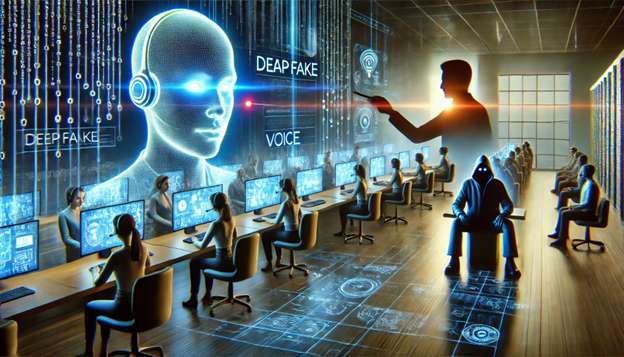
What Are Deepfake Virtual Contact Center Agents?
Deepfake virtual contact center agents are avatars of people backed by deep learning technology. These agents can be of real persons or even of fictitious personalities.
Their main use is in the customer relations criterion where the attendants communicate with clients through video calls, voice channels or face to face in a live chat. Unlike the previous types of chatbots these agents try to be as lifelike as possible in terms of looks and behavior.
How This Technology Affects Us
The impact of deepfake virtual contact center agents spans several dimensions:
- Customer Experience Enhancement
The agents can be really deepfaked and that would bring a whole new level of personalized self-service customer experiences. For instance, machines can incorporate lifelike options such as faces and natural language to give a more acceptable connection.They are useful for creating better relationships with customers, and helping them feel that their opinions are valued, thus improving the satisfaction of customers and the likelihood of them returning for future services.
- Cost Efficiency
The use of deepfake agents saves a lot of money for businesses. As for these agents, they do not require a day off, ever servicing all the hours in a day and attending to more than one customer at a time.This makes it easier to business, because the number of human agents to be hired is significantly lower than in traditional call centers. It economically serves the clients well and at the same time offers efficient service delivery.
- Ethical and Security Concerns
Deepfake tech is fun to interact with, but it has its dangers too. The opportunities for the malicious use exist, such as thieves getting users’ identities, fraudsters gaining access to users’ finance, or scammers relaying fake information.However, businesses need to be more careful with this technology fearing that might be misused to do harm for the customers or to scrape their information.
- Job Market Disruption
As these virtual agents develop, they are likely to takeover jobs such as customer service hence going down the employment scale. But the tech could present problems for the people needed to seek new opportunities for work.Effective efforts have to be made by society to encourage programs for reskilling and job transition as the economy changes.
Pros and Cons of Deepfake Virtual Contact Center Agents
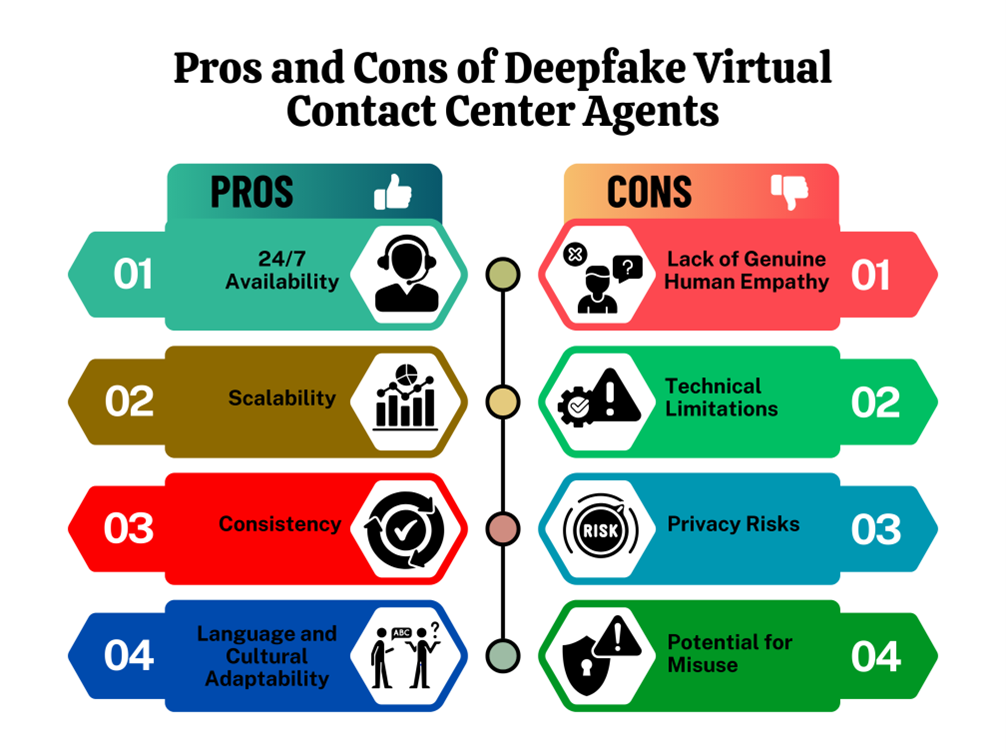
Using deepfake virtual contact center agents come with a number of advantages such as availability, flexibility, and standardization. Another advantage is that reusability of templates also makes it possible for content creators to this in a number of languages and cultures, giving businesses a powerful tool.
However, their application is problematic as it touches more on the following areas of ethical concern; security and job losses. In this section, we will review the pros and cons of deepfake virtual contact center agents.
Pros:
- 24/7 Availability:
Virtual agents do not have to limit access to customer support by getting tired; therefore, they can work around the clock.They can work at any time during the day or night, or even on national holidays that means they would also imply that they do not have any days off when it comes to helping their customers. This is quite useful for companies with customers across the world, operating at different times.
- Scalability:
Virtual agents, unlike human agents, do not ask for more staffing and training when traffic increases with clients.
Ideally, if a business is flooded with inquiries from its customers, especially during the festive season, or when there is a sale, the virtual agents can easily take on more tasks meaning that customers will be attended to promptly and the firm will not be under pressure. - Consistency:
Compared to human agents one can receive different results for a number of reasons including but not limited to tiredness or mood, virtual agents will provide the consumer with consistent quality service delivery each and every time.
They engage in similar processes and practices, thus providing customers with uniform and correct information and thus minimize mistakes throughout serving the clients. - Language and Cultural Adaptability:
Virtual agents are capable of being developed on a range of languages and this will enable business personnel are able to connect with an international audience. They also can change their keywords and answers to be more appropriate thus making every client from different cultural backgrounds to feel that they are being valued.
The flexibility that results from such approaches enhances the coverage area of business and thus customer satisfaction.
Cons:
- Lack of Genuine Human Empathy:
Virtual agents may be programmed to give parcels of emotional responses via different body postures and intonation color but they do not comprehend emotions.
When customers want guidance, sympathy or understanding–as in a complaint or a personal problem–this absence of genuine concern will make the interaction seem stilted or unemotional which will not meet the customers’ needs. - Technical Limitations:
These agents are what is known as deepfake and rely on multiple algorithms and various models of Artificial Intelligence. Although they can perform most operations, such systems are not infallible and can have difficulty with extraordinary or complex cases.
For instance, the agent may create responses that are clumsy or wrong, if a client uses unfamiliar accents, colloquialisms or ambiguous questions — this results in customer frustration. - Privacy Risks:
Some consumers may be reluctant to provide identifiable characteristics to the virtual agent particularly where they cannot tell that it is an artificial intelligence.
This may result from some form of an issue with the manner in which their data is collected, processed, or managed. When customers feel that there privacy is not being protected, they are likely to stop using the service or complaint of possible data hazards. - Potential for Misuse:
Deepfake technology in its turn can be used for rather immoral purposes, for instance, forming the fake voices or the images in purpose of deception. If businesses employ deepfake agents of people with no proper disclosure of the real state, customers stand to be deceived.
The Future of Deepfake Virtual Contact Center Agents
The future of deepfake virtual agents looks promising yet complex. Here are some key trends and considerations:
Advancements in AI and Deep Learning
As AI technology continues to advance, deepfake agents will become increasingly realistic and capable. Enhanced natural language understanding and emotion recognition will make interactions more seamless and human-like.
Regulation and Ethical Standards
To address privacy and security concerns, governments and organizations will likely introduce regulations and ethical guidelines for the responsible use of deepfake technology. Transparency will be crucial, ensuring customers know they’re interacting with a virtual agent.
Integration with Other Technologies
Deepfake agents could be integrated with other emerging technologies such as augmented reality (AR) and virtual reality (VR), creating even more immersive customer experiences.
Human-Agent Collaboration
Rather than fully replacing human agents, deepfake agents may serve as support tools, handling routine inquiries while allowing human agents to focus on complex or emotionally sensitive cases.
Conclusion
Deepfake virtual contact center agents represent a groundbreaking shift in customer service, offering both opportunities and challenges. While they have the potential to revolutionize the way businesses interact with customers, careful consideration of ethical, technical, and societal implications is essential.
As this technology evolves, striking a balance between innovation and responsibility will be key to unlocking its full potential while minimizing risks.